An independent practitioner publication / First Edition
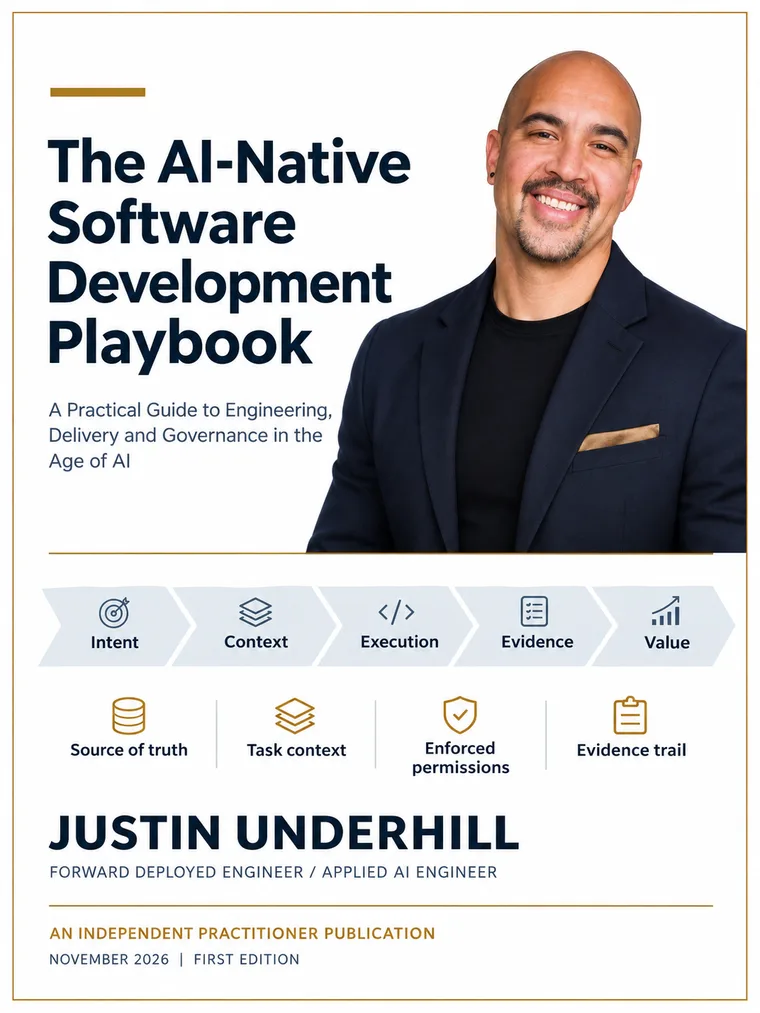
The AI-Native Software Development Playbook
A Practical Guide to Engineering, Delivery and Governance in the Age of AI
The complete First Edition to read online: executive summary, ten chapters, four appendices and references. A companion implementation, ServiceFlow v1.0.0, makes the controls inspectable.
Contents
Introduction
Appendices
Chapters
- 01The evolution of software developmentFrom code-centric execution to AI-native delivery.
- 02Five industry approaches, one accountable workflowWhere Anthropic, AWS, Atlassian, Google and OpenAI converge—and where they do not.
- 03From business intent to engineering requirementsTurn ambiguous requests into verifiable engineering intent.
- 04Context engineering and the agent-ready projectGive agents the right context, not unlimited access.
- 05The AI-native development workflowBound the work. Verify the evidence.
- 06Quality, security and governanceTreat autonomy as a risk decision.
- 07The evolving engineering teamRedesign responsibilities without losing ownership.
- 08Measuring performance and business valueMeasure valuable delivery, not generated output.
- 09Adopting AI-native developmentPilot safely, learn quickly and scale deliberately.
- 10ServiceFlow: from principle to passing testsA companion implementation readers can run, inspect and adapt.
Executive summary
AI-native software development is an operating model, not a faster way to produce code. It brings AI into discovery, specification, implementation, verification and operations while keeping decision rights explicit. The governing question is not how autonomous an agent can become, but whether every material change can be traced from business intent to credible evidence and accountable approval.
For technology leaders, the practical starting point is a constrained pilot: choose a measurable delivery bottleneck; establish authoritative requirements, threat assumptions and acceptance criteria; permit agents to execute within narrow permissions; and require checks outside the agent session. Treat advisory instructions and hooks as useful controls within their scope, not substitutes for application authorisation or repository-enforced merge gates.
ServiceFlow, the public companion application, provides an auditable example. Two work packets produced tests-first security fixes, a human-owned 404/403 authorisation decision, AI-assisted reviews, locked dependencies and a protected CI merge gate. Its verified v1.0.0 release includes 20 tests passing on Python 3.11, 3.12 and 3.13. The release is an educational reference, not evidence of production readiness or measured business improvement.
Executive action: appoint decision owners, define which gates automation may close, instrument baseline outcomes and failure rates, and expand only after the evidence shows that quality and delivery have improved. The chapters provide the workflow, control patterns and reusable templates behind this recommendation.
How to use this playbook
This guide is for teams moving beyond individual coding assistants toward end-to-end AI-supported software delivery. It does not prescribe one model, IDE, cloud or project-management framework. Its goal is to help readers decide where AI belongs, what context it needs, how outputs are checked, and who remains accountable.
Read Chapters 1–5 to design a workflow, Chapters 6–8 to govern and measure it, Chapter 9 to pilot it responsibly and Chapter 10 to see these practices applied in the ServiceFlow companion implementation. The appendices contain templates intended to be adapted, not adopted unquestioningly.
Who this guide is for: software engineers, architects, business analysts, product owners, security practitioners, engineering leaders and delivery managers. Chapters explain the shared decisions; the companion ServiceFlow repository contains runnable code for readers who want to inspect the controls. The reference implementation is educational, not production software.
Central proposition
AI-native software development is the disciplined integration of AI across software delivery, with context-rich delegation, verifiable outputs, proportionate automation, and explicit human accountability.
Evidence and interpretation
The five foundational sources are from Anthropic [1], AWS [2–3], Atlassian [4], Google [5] and OpenAI [6]. Each represents its publisher’s experience and commercial perspective. This book interprets their common themes, challenges their assumptions where appropriate, and uses independent measurement and security references [7–9]. Illustrative examples are not evidence of real-world performance.
Companion source: ServiceFlow is published at https://github.com/justinunderhill/serviceflow-ai-native-playbook with runnable FastAPI code and reproducible tests. See AGENTS.md, tests/test_approval.py and docs/adr/003-approval-authorisation.md. The repository is MIT-licensed separately from the book; its application and credentials are for local education, not production deployment.
The running example: ServiceFlow
ServiceFlow is a fictional internal request-management product. A mid-sized organisation uses shared inboxes and spreadsheets to handle equipment and access requests. The proposed application must support submission, departmental approval, status visibility, notifications, role-based permissions and reporting. Each chapter follows one aspect of this system from intent through safe operation.